Geotechnical Engineering in Jacksonville

Together, we solve the challenges of tomorrow.

LEARN MORE →

Jacksonville sits at just 16 feet above sea level, spread across 874 square miles of coastal plain that conceals everything from Pleistocene sand ridges to compressible organic deposits near the St. Johns River. That surface uniformity is deceptive, and anyone who has excavated for a foundation in Riverside or graded a site in Bartram Park knows the subsurface can change dramatically within a few hundred feet. A proper soil mechanics study here is not a formality; it is the only way to reconcile what the site gives you with what the structure demands. We run the lab tests and field programs that feed directly into bearing capacity calculations, settlement predictions, and lateral earth pressure models, because the numbers have to work before the concrete goes in. For deeper investigations where blow counts drive the design, we often pair the soil mechanics program with spt-drilling to get continuous refusal data through the sand and shell layers typical of Duval County.

Jacksonville's coastal plain soils can shift from clean sand to compressible organics within a single boring; the soil mechanics study defines every layer so the foundation design matches the actual subsurface.
Geotechnical Engineering in Jacksonville
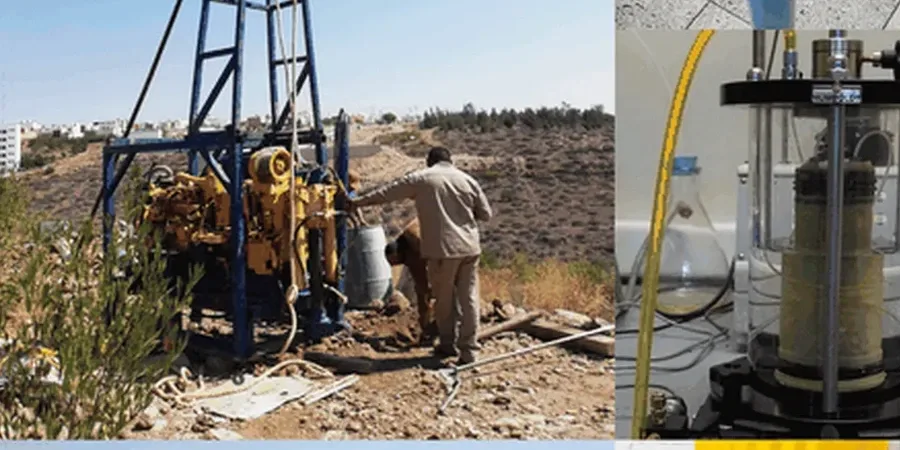
Technical reference image — Jacksonville

How we work

One thing we see repeatedly in Jacksonville is that standard penetration resistance can swing from N=4 to N=35 in the same boring, simply because the drill passed through an old marsh deposit into a Pleistocene sand unit. That kind of variability means the soil mechanics study cannot rely on a single average value; it has to define the range and the spatial distribution. We run consolidated-undrained triaxial tests where cohesive layers are thick enough to matter, and direct shear on the sands to pin down the friction angle for bearing capacity and retaining wall design. Grain size distributions from grain-size sieve and hydrometer runs help classify the material per ASTM D2487, which feeds directly into the USCS group symbol that drives many of the empirical correlations used in settlement and liquefaction screening. Atterberg limits, moisture content profiles, and unit weight determinations round out the index properties so the foundation engineer has a complete picture before selecting the footing type or deep foundation system.

Local geotechnical context

The contrast between the downtown core and the beaches illustrates exactly why a soil mechanics study has to be site-specific in Jacksonville. Downtown and the near-west side sit on older Pleistocene terraces with relatively competent sands that can handle significant bearing pressures with moderate footing dimensions. Drive 15 miles east to Atlantic Beach, and you are dealing with Holocene beach ridge deposits underlain by shallow water tables and occasional pockets of organic silt that compress under load and amplify differential settlement. The risk is not that the soil fails catastrophically on day one; it is that five years later the slab corners have dropped half an inch and the drywall is telling the story. A soil mechanics study that quantifies consolidation potential and shear strength for each distinct layer is what separates a foundation that stays level from one that slowly drifts out of tolerance. For projects near the river or its tributaries, where soft ground is the rule rather than the exception, we often integrate stone-columns into the ground improvement design once the soil parameters are defined.

Need a geotechnical assessment?

Reply within 24h.

Email: contact@geotechnical-engineering.vip

Typical values

ParameterTypical value
Unit weight (total)105-130 pcf (sand), 90-115 pcf (silt/clay)
Effective friction angle (sand)30°-38° per direct shear / triaxial
Undrained shear strength (cohesive)200-1,500 psf typical for NE Florida clays
Compression index Cc0.15-0.40 for compressible organic silts
SPT N-value range (upper sand)8-35 blows/foot, highly variable
Groundwater depth2-8 feet bgs in much of Duval County
Liquefaction screeningPer Idriss & Boulanger (2014) for loose saturated sands

Complementary services

01

Field investigation and sampling

Drilling, SPT sampling, Shelby tubes in cohesive layers, and groundwater monitoring across Duval, St. Johns, and Clay counties. We log every foot of recovery so the lab program matches the stratigraphy.

02

Laboratory testing program

Triaxial, direct shear, consolidation, Atterberg limits, grain size, and moisture-density relationships per ASTM standards. Results are packaged with interpreted design parameters for bearing capacity, settlement, and lateral earth pressure.

Regulatory framework

ASTM D1586 – Standard Test Method for Standard Penetration Test (SPT), ASTM D2487 – Classification of Soils for Engineering Purposes (USCS), ASTM D4767 – Consolidated-Undrained Triaxial Compression Test, IBC 2021 Chapter 18 – Soils and Foundations, ASCE 7-22 – Minimum Design Loads (seismic site class determination)

Questions and answers

What does a soil mechanics study cost for a typical Jacksonville commercial building site?

For a single-story commercial pad or small multi-story building in Jacksonville, the combined field investigation and lab program generally falls between US$3,440 and US$5,580. The spread depends on boring depth, number of samples, and whether triaxial or consolidation tests are required for the specific stratigraphy encountered.

How deep do you test for a soil mechanics study in Jacksonville?

Minimum boring depth follows IBC Chapter 18 and typically extends to at least 30 feet below grade for spread footings, or deeper if pile foundations are anticipated. In Jacksonville, we often deepen borings when soft organic layers are encountered below 20 feet, to ensure we reach a competent bearing stratum with sufficient SPT refusal data.

Do Jacksonville sites need liquefaction screening as part of the soil mechanics study?

Yes. Although Northeast Florida is not as seismically active as the West Coast, the IBC and ASCE 7-22 still require site class determination and liquefaction screening where loose saturated sands exist within 50 feet of grade. Our soil mechanics study includes the SPT-based screening per Idriss & Boulanger methodology when the stratigraphy and groundwater conditions trigger the requirement.
Location and service area

We serve projects in Jacksonville and surrounding areas.

View larger map