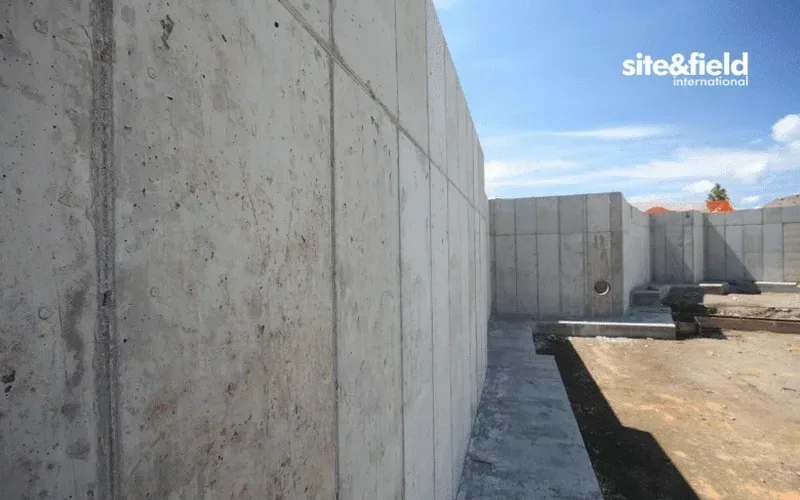
Jacksonville's flat topography hides a critical underground challenge: the water table sits just a few feet below the surface across much of Duval County. When you excavate for a retaining wall near the St. Johns River or in the Intracoastal Waterway corridor, you hit saturated sands almost immediately. That changes everything about the wall design. Standard gravity walls often fail here because they don't account for the buoyant unit weight of the backfill. We incorporate pore pressure distribution into every retaining wall design from the start, not as an afterthought. A test pit inspection gives us the first visual confirmation of the sand's density and moisture profile, and we often pair it with an SPT drill to quantify the friction angle before we ever open the wall geometry software.
In Jacksonville, a retaining wall without a drainage plan is a future failure. We design the water out of the problem.
How we work
Our approach to retaining wall design for Jacksonville projects starts with the subsurface investigation, not the wall dimensions. We run ASTM D1586 standard penetration tests and sieve analyses per ASTM D2487 to classify the local sands, which are predominantly SP and SP-SM in the coastal plain deposits. The wall type selection comes from that data. For typical residential lots in Mandarin or Riverside, a cantilever reinforced concrete wall with a heel length calibrated to the active earth pressure coefficient works well. For taller commercial cuts near the river, we shift to mechanically stabilized earth walls with geogrid reinforcement layers spaced at 18 to 24 inches. We calculate global stability with Spencer's method because Bishop's simplified method underestimates the failure surface when the phreatic surface is high. Every design includes a drainage blanket specification; without it, hydrostatic pressure builds behind the wall and the factor of safety drops below 1.0 within a single wet season.
Local geotechnical context
Jacksonville's 2023 population exceeded 990,000, and growth is pushing development into low-lying areas where retaining wall design faces compound risks. The city sits in a hurricane-prone zone, and the storm surge from a Category 3 event can raise the groundwater level by several feet in a matter of hours. A wall designed for static conditions can experience a 40% reduction in factor of safety under rapid drawdown or elevated phreatic surface. The IBC 2021 and ASCE 7-22 require consideration of flood loads and scour effects for structures in flood hazard zones, which covers large portions of Jacksonville near the river and tributaries. We also evaluate the potential for internal erosion of fine sand through the drainage aggregate, a failure mode that silently undermines the wall over two or three rainy seasons before it becomes visible at the face.
Regulatory framework
IBC 2021 (International Building Code) - Section 1807 Earth Retaining Structures, ASCE 7-22 Minimum Design Loads for Buildings and Other Structures, ASTM D1586 Standard Test Method for Standard Penetration Test (SPT) and Split-Barrel Sampling of Soils, ASTM D2487 Standard Practice for Classification of Soils for Engineering Purposes (Unified Soil Classification System), AASHTO LRFD Bridge Design Specifications, Section 11 (retaining wall design)
Questions and answers
How much does a retaining wall design cost in Jacksonville?
Retaining wall design costs in the Jacksonville area typically range from US$970 for a straightforward residential wall design on a standard lot to US$4,550 for a full commercial package with SPT borings, laboratory testing, and detailed calculations for walls exceeding 12 feet in height. The final cost depends on wall height, site access, and whether we need to run additional slope stability analyses.
Do I need a building permit for a retaining wall in Jacksonville?
Yes, the City of Jacksonville requires a building permit for retaining walls over 3 feet in height. The permit submittal must include signed and sealed design calculations prepared by a Florida-licensed professional engineer, plus a site plan showing the wall location and any easements. We prepare the complete calculation package for your permit application.
What type of retaining wall works best with Jacksonville's sandy soil?
Cantilever reinforced concrete walls perform well for heights up to about 15 feet, provided the heel extends far enough into the competent sand and a granular drainage blanket is included behind the wall. For taller walls or sites with very loose sand, we often recommend mechanically stabilized earth walls because they tolerate more deformation and distribute loads through geogrid layers into the soil mass.