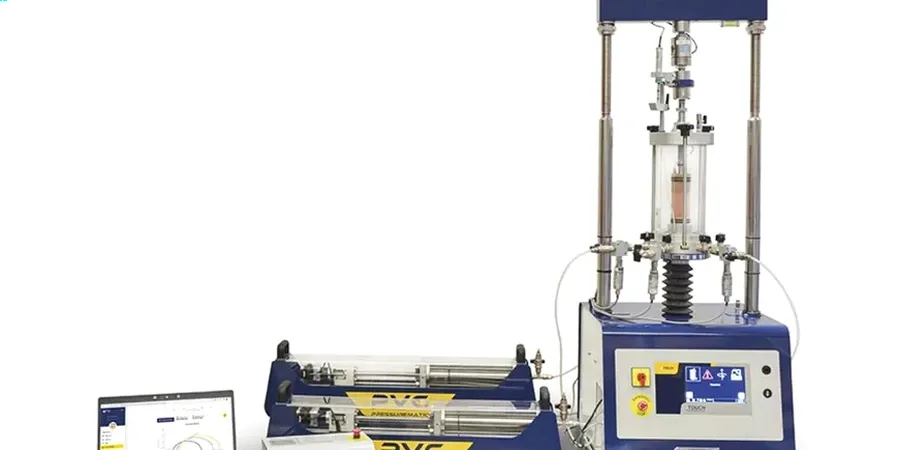
Jacksonville’s skyline didn’t just rise overnight. The consolidation of Duval County in 1968 spurred downtown high-rise development that still demands precise geotechnical assessment, especially where the St. Johns River cuts through ancient marine terraces. Our laboratory runs triaxial shear tests to define the effective stress parameters that govern foundation performance in this region. We see a lot of sandy clay and silty sand from the Hawthorne Group—materials that behave differently under rapid loading compared to slow drained conditions. That’s why we don’t just run one test type and call it done. The CPT test often flags the depth of soft layers, and we follow up with consolidated-undrained triaxial stages to quantify undrained shear strength before the first pier is cast.
Triaxial testing mimics real subsurface stress paths—confining pressure, drainage control, and pore-water measurement—in a way that direct shear simply cannot replicate.
Questions and answers
What does a triaxial test program for a Jacksonville high-rise typically cost?
A three-stage CU program on Shelby tube samples from one borehole, including B-check saturation and ASTM D4767 reporting, runs between US$1,910 and US$2,900. The range depends on whether we’re testing intact specimens or remolded material, and how many confining pressure points the engineer specifies.
How long does the lab need to complete a CU triaxial series?
Saturation and consolidation alone can take 48 to 72 hours for fat clays with low permeability. Shear at the correct strain rate adds another 4 to 6 hours per stage, so a three-stage CU series typically reports within five working days after sample acceptance.
How do you decide between UU, CU, and CD triaxial testing?
The choice depends on the field loading rate and drainage conditions. UU applies to rapid loading where no drainage occurs (embankment failures during construction). CU is for cases where the soil has consolidated under existing stress but will be loaded quickly afterward (foundations on saturated clay). CD suits slow, steady loading with full drainage (long-term slope stability, sand fills). We always run a particle-size analysis first to confirm the soil class before selecting the drainage protocol.