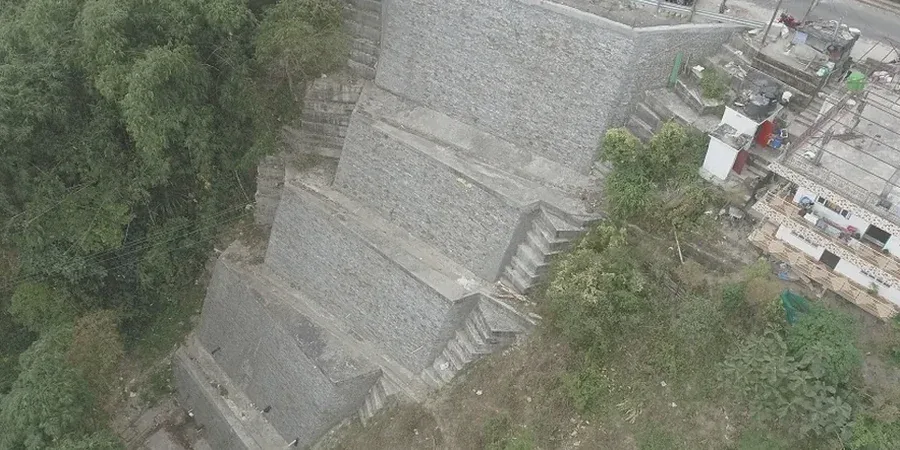
Jacksonville presents a study in contrasts from a geotechnical perspective—the well-drained sandy ridges of the Mandarin area behave nothing like the soft, organic-rich deposits common near the Trout River. Where one site might hold a 2:1 cut without issue, another just a few miles away can creep after a single heavy storm season. This variability is why a rigorous slope stability analysis becomes indispensable, especially when grading plans intersect the loose Pleistocene sands and occasional clay lenses that define much of Duval County’s subsurface. Having worked across projects from the St. Johns Town Center expansion to infill sites near Springfield, we consistently combine test pits to map shallow stratigraphy with laboratory shear strength testing—because assuming uniform conditions here leads to expensive surprises. Jacksonville’s subtropical climate adds another layer: intense summer rainfall infiltrates quickly through the sandy overburden, temporarily reducing matric suction and triggering shallow failures that a properly parameterized model can anticipate. For deeper cuts or embankments near retention ponds, we often recommend pairing the analysis with a CPT sounding program to capture continuous pore pressure data without the disturbance inherent in conventional sampling.
A slope that stands today in Jacksonville’s dry season can fail in August without any change in geometry—the trigger is pore pressure, and it moves faster than most engineers expect.
How we work
Jacksonville sits at a low elevation—roughly 12 feet on average—but don’t let the flat topography mislead you. The city’s 875,000 residents live atop a hidden karst landscape, where ancient sinkholes have filled with variable mixtures of sand, silt, and decomposed limestone that create abrupt strength transitions over distances of less than 30 feet. Our slope stability work here starts with the Florida Building Code Chapter 18 soils provisions and ASCE 7-22 seismic parameters, though the dominant triggering mechanism we see is hydraulic rather than tectonic: prolonged rainfall raises the phreatic surface in sandy layers, reducing effective stress to near zero in the upper 10 to 15 feet. We quantify this behavior through consolidated-undrained triaxial tests on undisturbed Shelby tube samples, then feed the resulting effective stress parameters into limit-equilibrium models that account for transient seepage. For slopes exceeding 20 feet, we routinely implement Spencer’s method to satisfy both force and moment equilibrium simultaneously, avoiding the unconservative assumptions of simpler Bishop analyses. The analysis output doesn’t just produce a factor of safety number—it identifies the critical failure surface geometry and the reinforcement depth needed if stabilization measures become necessary.
Questions and answers
What does a slope stability analysis cost for a typical Jacksonville commercial site?
For a mid-size commercial parcel in Duval County—think a 2- to 5-acre lot with cuts under 25 feet—the analysis, including field investigation, laboratory shear strength testing, and limit-equilibrium modeling, typically ranges from US$1.180 to US$3.660. The spread depends on how many borings are needed, whether we run consolidated-undrained triaxial tests or simpler direct shear, and if transient seepage modeling is required. Sites with known karst features or deeper cuts push toward the upper end because we need more subsurface data to constrain the model reliably.
How does Jacksonville’s karst geology affect slope stability calculations?
The karst terrain introduces abrupt stratigraphic changes—sinkhole-filled depressions can contain soft organic silts directly adjacent to competent limestone, sometimes within the footprint of a single slope. We address this by running probabilistic analyses that vary the shear strength parameters spatially, rather than assuming a single homogeneous profile. Cone penetration testing (CPT) helps us map the transitions, and we often include a sensitivity analysis that shows how the factor of safety changes if a clay-filled cavity is encountered at different depths.
What factor of safety does the Florida Building Code require for permanent slopes?
IBC Chapter 18 and the Florida Building Code—Existing Building don’t specify a single number for all slopes, but the standard of practice in Jacksonville and statewide follows the FHWA and Corps of Engineers guideline of a minimum static factor of safety of 1.50 for permanent slopes and 1.10 for the pseudo-static seismic condition. For temporary construction cuts, 1.30 is often accepted, though we typically recommend staying above 1.40 given the rapid strength loss we observe during heavy rainfall periods.
How long does the analysis take, and what deliverables do we receive?
A standard slope stability study—fieldwork through final report—takes three to four weeks for most Jacksonville projects. Field investigation and lab testing consume the first two weeks; the modeling and reporting fill the remainder. The deliverable is a sealed geotechnical report containing the limit-equilibrium model outputs, critical failure surface geometry, recommended slope configuration or reinforcement layout, drainage provisions, construction monitoring triggers, and the governing factor of safety under both static and seismic conditions per ASCE 7-22.