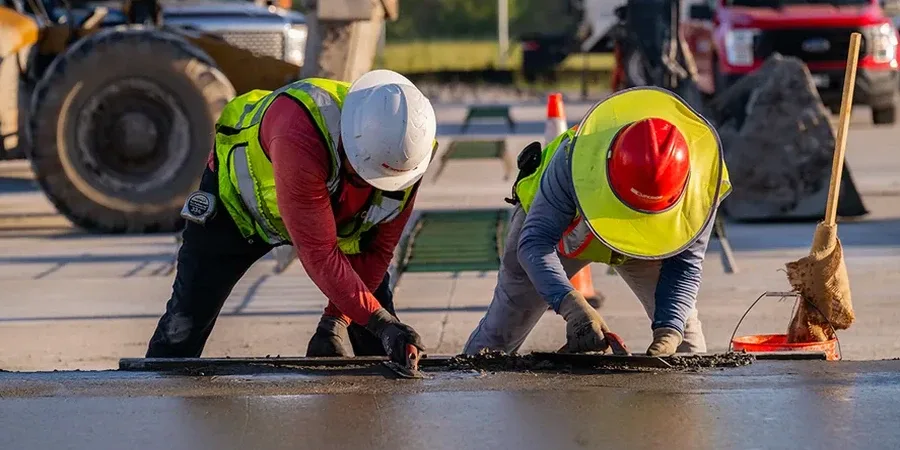
The slipform paver moves through the Jacksonville heat, extruding a dense concrete slab in a single pass. For rigid pavement design in this part of Florida, the real engineering lies beneath that slab. Jacksonville sits on the Atlantic Coastal Plain, with surface geology dominated by Pleistocene terrace deposits — sands, silty sands, and occasional clay lenses that shift with seasonal moisture. The water table is often less than five feet below grade. A pavement section designed without accounting for these conditions will pump fines, fault at the joints, and crack within three wet-dry cycles. We evaluate the subgrade reaction modulus (k-value) directly, not from textbook tables, because the variability across Duval County — from the well-drained sands near the St. Johns River bluffs to the organics west of I-295 — demands site-specific data.
This is where our approach to in-situ permeability testing becomes essential, quantifying drainage capacity before a single joint pattern is drawn, and where CBR road testing provides a secondary check on subgrade stiffness under saturated conditions.
A rigid pavement in Jacksonville lives or dies by its subbase drainage — the slab itself is rarely the failure point.
Local geotechnical context
Jacksonville's post-war expansion pushed development into low-lying areas that had been pine flatwoods and cypress swamps for centuries. Fill was placed — sometimes clean sand, sometimes construction debris — and compacted to specifications that predate modern IBC requirements. Rigid pavement built over these fills now contends with differential settlement, organic decomposition, and erratic subgrade stiffness. The Great Fire of 1901 reshaped downtown, but the geotechnical legacy in the urban core includes buried ash layers and old foundations that create hard-soft transitions under a pavement slab.
Pumping at joints and corners is the first visible symptom, but the root cause is a loss of support beneath the slab. We analyze these conditions using plate load testing to verify k-value assumptions directly, and sand cone density testing to confirm subgrade compaction before the base course is placed. A pavement design that ignores Jacksonville's fill history will fail at the joints long before the concrete reaches its design life.
Questions and answers
What is the typical cost range for rigid pavement design on a Jacksonville commercial project?
Engineering fees for rigid pavement design on a typical commercial or light industrial project in Jacksonville range from US$1,980 to US$6,900, depending on the number of borings, plate load tests, and the complexity of joint detailing required.
How does Jacksonville's high water table affect rigid pavement performance?
The water table across much of Jacksonville sits within five feet of the surface. This saturates the subgrade and subbase, which can lead to pumping at joints — fine soil particles ejected under slab deflection during heavy loading. We mitigate this with open-graded drainage layers, edge drains, and sometimes cement stabilization of the upper subgrade.
Do you use the AASHTO 1993 method or the newer MEPDG for Jacksonville pavements?
We work with both, depending on the project requirements. The AASHTO 1993 method remains widely accepted for standard commercial pavements. For heavy-duty industrial sites or port-related traffic, we apply the Mechanistic-Empirical Pavement Design Guide (MEPDG) to model axle load spectra and Jacksonville's specific climate inputs.
What joint spacing do you recommend for unreinforced concrete slabs in north Florida?
For unreinforced rigid pavement in Jacksonville, we typically specify joint spacing at 24 to 36 times the slab thickness — roughly 12 to 18 feet for an 8-inch slab. The exact spacing depends on the coefficient of thermal expansion of the aggregate, slab thickness, and the friction characteristics of the subbase surface.