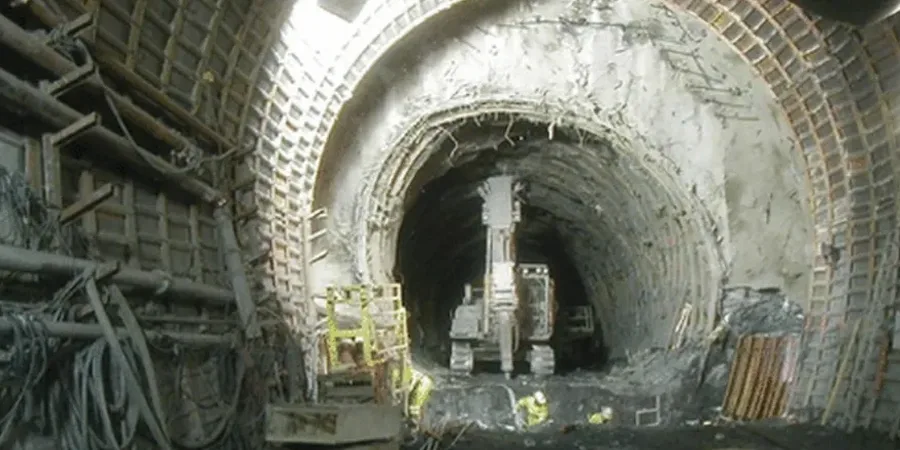
When a contractor hits a lens of loose silty sand at 28 feet beneath Bay Street, just blocks from the St. Johns River, the entire excavation sequence can shift in a matter of hours. Jacksonville sits on a coastal plain where Pleistocene and Holocene deposits create alternating layers of clay, sand, and organic silt that complicate any underground opening larger than a utility vault. The high water table, rarely more than four or five feet below grade in the urban core, means tunnel faces stay saturated through most of the year. Our team supports design-build groups and municipal agencies with a geotechnical program built around the specific demands of soft ground tunneling: undisturbed sampling with thin-wall Shelby tubes, consolidated-undrained triaxial tests per ASTM D4767, and pore pressure dissipation models that feed directly into the excavation support design. While the tunnel alignment defines the corridor, the ground defines the risk profile, and we approach each project by mapping that risk long before the first shove of a shield machine. For deeper sections where mixed-face conditions appear, we often pair the investigation with CPT testing to obtain continuous stratigraphic profiles, and we rely on triaxial shear data to capture the undrained strength envelope that governs face stability.
Face stability in Jacksonville's soft ground is driven more by pore pressure response than by total stress, and ignoring that distinction is what turns a routine drive into a sinkhole.
Questions and answers
What makes Jacksonville's soil challenging for tunnel boring?
The challenge lies in the rapid vertical and lateral variability. Pleistocene sands, Holocene clays, and pockets of organic silt alternate within short distances, often below a water table that sits only a few feet under the surface. This creates mixed-face conditions where a tunnel crown is in soft clay while the invert is in running sand, demanding constant adjustment of face pressure and conditioning agents.
How do you determine the right tunnel depth for a soft ground project in Jacksonville?
We match the alignment options against the stratigraphic profile derived from borings and CPT soundings. The goal is to place the tunnel within a uniform material layer whenever possible, avoiding the contact zone between sand and clay. Minimum cover is checked against blowout risk under pressurized face conditions, and the depth is verified against the groundwater table measured across at least one full seasonal cycle.
What is the typical cost range for a geotechnical investigation for soft soil tunnels in Jacksonville?
The investigation scope drives the cost, but for a utility or transit tunnel alignment in Jacksonville, the program usually falls between US$4,210 and US$18,740. That range covers a combination of borings, CPT soundings, laboratory testing, and the engineering report with face stability and settlement predictions.
Which laboratory tests are essential for tunnel design in coastal sediments?
Consolidated-undrained triaxial compression tests (ASTM D4767) are essential for undrained strength. One-dimensional consolidation tests provide the compression index and preconsolidation pressure used in settlement modeling. Grain-size distribution and Atterberg limits classify the material and feed into soil behavior type charts that guide TBM operation parameters.