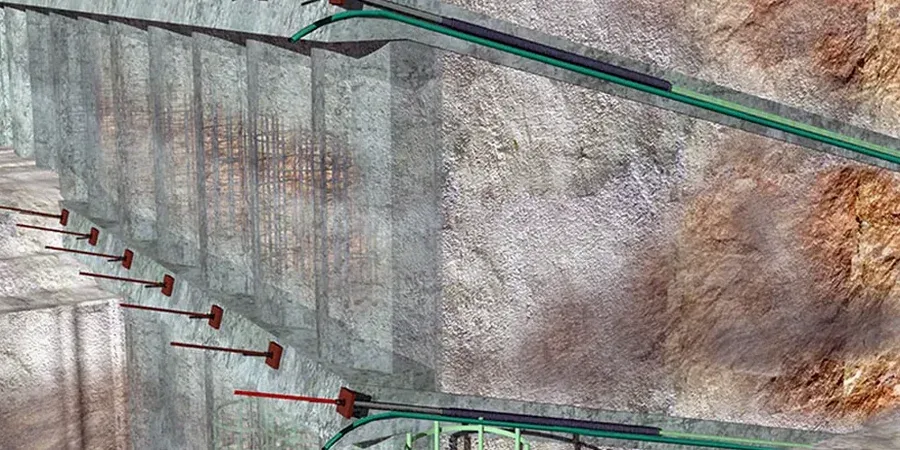
In Jacksonville, we see a lot of projects where the difference between a straightforward shoring job and a costly failure comes down to anchor selection. Much of the city sits on the Hawthorne Group—interbedded sands, clays, and phosphatic limestone—which doesn't always behave predictably under tension. You can't just pull a generic design off the shelf. Our team focuses on active and passive anchor design that accounts for the local stratigraphy, the shallow water table, and the real loads a structure will see over time. When the soil profile shows loose sands overlying stiff clay, we often specify a strand anchor with a bonded length pushed deep enough to bypass the weathered zone. The process starts with logging the subsurface, which is why we frequently pair anchor design with an SPT drilling program to get refusal depths and SPT N-values that feed directly into the capacity calculations. And in areas near the St. Johns River, where the upper soils are organic, we pull undisturbed samples for grain-size analysis and consolidation testing to validate the grout-to-ground bond assumptions before finalizing the anchor spacing.
An anchor's capacity lives in the bond zone—and in Jacksonville, that zone shifts with the water table and the Hawthorne formation.
How we work
Jacksonville's consolidation in 1968 merged a sprawling city with distinct soil profiles—from the sandy ridges of the Atlantic Coastal Plain to the marshlands along the Trout River. That history left us with a patchwork of fill, natural levees, and deep soft clays that directly impacts anchor design. A passive anchor system, like a deadman or a grouted bar relying solely on bearing resistance, works well in the dense sands found in parts of Southside, where you can develop lateral capacity at relatively shallow depths. But out west near Baldwin, where the limestone caprock is shallower, active post-tensioned anchors become the more practical choice because you need to lock off a known load and monitor for creep. We run proof tests on every production anchor, typically following ASTM D4435 for rock and D3689 for soil. The key parameter we watch isn't just the ultimate capacity—it's the unbonded length. Get that wrong in a soil profile with multiple water-bearing layers, like the surficial aquifer common across Duval County, and you'll lose the free-stressing length needed to maintain the lock-off load. Our lab verifies the cement grout mix design for bleed and compressive strength at 7 and 28 days before any anchor is installed.
Local geotechnical context
When we mobilize a hydraulic hollow-stem auger rig for anchor installation in Jacksonville, the first thing we watch is the return flush. If the drilling fluid starts bringing up dark, organic clay from the Pamlico formation or the Mathews member, we know the bond zone needs to be pushed deeper or the grout mix adjusted for a wetter hole. The biggest risk in anchor design here isn't steel failure—it's a bond failure at the grout-soil interface. We've seen projects where the anchor was designed off a single boring that missed a thin, saturated silt lens, and the proof test showed excessive creep at just 133% of the design load. That's why we correlate multiple exploration points and run a quick Atterberg limits test on any cohesive layer that might be in the bond zone. The IBC requires a minimum factor of safety of 2.0 for permanent anchors, but in Jacksonville's aggressive coastal environment, we also have to account for long-term corrosion. A passive anchor with no active monitoring might be cheaper upfront, but if it's in a fluctuating groundwater zone near the Intracoastal, the owner could be looking at hidden degradation that nobody catches until a wall starts to deflect.
Regulatory framework
ASTM D4435-13e1 (Rock Bolt Anchor Pull Test), ASTM D3689-07(2013) (Anchor Pull Test in Soil), PTI DC35.1-14 (Recommendations for Prestressed Rock and Soil Anchors), AASHTO LRFD Bridge Design Specifications, 9th Edition, IBC 2021 (Florida Building Code, 8th Edition)
Questions and answers
What's the cost range for active/passive anchor design in Jacksonville?
For a typical shoring or retaining wall project in Jacksonville, the anchor design and testing package runs between US$1,130 and US$3,570, depending on the number of anchors, the complexity of the soil profile, and the level of testing required. A straightforward passive tieback design with a couple of proof tests falls on the lower end, while a multi-row active post-tensioned system with full creep monitoring and a grout QA/QC program comes in higher.
How do you determine the bond length in Jacksonville's Hawthorne Group soils?
We base the bond length on the SPT N-values and the undrained shear strength from lab tests on Shelby tube samples. The Hawthorne Group's interbedded nature means we can't rely on a single average—we calculate the bond stress for each distinct layer along the borehole and sum the contributions. A field proof test then validates the design assumption, and we tweak the bonded length if the creep rate exceeds the allowable limit.
Is there a difference in permitting for active vs passive anchors in Duval County?
The Florida Building Code doesn't differentiate between active and passive anchors in terms of permitting, but the submittal requirements change. Active post-tensioned anchors require a signed and sealed design with the lock-off load, unbonded length detail, and testing procedure clearly stated. Passive systems are often treated as reinforced earth elements, and the review focuses on the bearing capacity and pullout resistance. Both need to show compliance with the IBC's corrosion protection requirements for permanent structures.